WHY AIRDOOR > Sustainability
Lower carbon impact at open entrances
AirDoor supports sustainability and net‑zero ambitions by consuming less energy than traditional overdoor heaters and reducing energy loss, heating demand and carbon emissions at the entrance, without compromising comfort, access or performance.
How AirDoor supports sustainability
Consumes less energy than traditional overdoor heaters
Unlike traditional overdoor heaters, AirDoor operates without any heating or cooling element, avoiding the high energy demand associated with continuously generating heat at open entrances. Instead, it uses a smart control strategy and variable‑speed fans to respond only when required, consuming the minimum energy needed to manage entrance infiltration.
By combining sensor‑controlled operation with the absence of energy‑intensive heating, AirDoor delivers a significantly lower operational energy footprint than conventional entrance systems, embedding sustainability into the way the entrance performs rather than adding it as an afterthought.

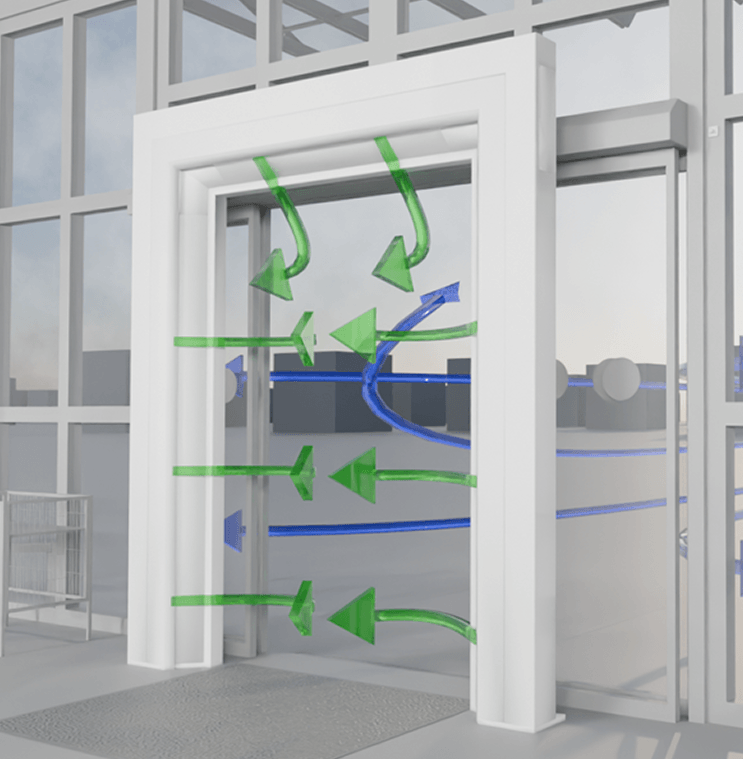
Reduces energy loss and carbon emissions at the entrance
By keeping treated indoor air inside the building and limiting unconditioned air from entering, AirDoor reduces key sources of energy loss at open entrances. This stabilises conditions at the doorway and lowers the heating and cooling demand required to maintain comfortable internal environments.
As both product‑level energy use and system‑level demand are reduced, carbon emissions associated with entrance operation fall accordingly. Energy analysis from a single AirDoor installation at a UK supermarket showed carbon savings of around 15,000 kg of CO₂ per year*, directly linking improved entrance control to measurable emissions reduction.
*Energy analysis from a single AirDoor installation at a UK supermarket showed reductions in average daily gas and electricity use of 154 kWh and 177 kWh respectively, delivering a conservative saving of around 15,000 kg of CO₂ per entrance per year (based on BEIC Conversion Factors).
Supports net‑zero strategies with proven, scalable impact
AirDoor is increasingly used as part of long‑term sustainability and net‑zero programmes, where reducing operational energy use across building portfolios is essential. Its ability to deliver measurable performance at open entrances makes it a practical, repeatable solution for deployment across multi-site estates.
This approach has been independently recognised through an Energy Saving Awards win and by inclusion in the published sustainability and climate strategies of major organisations, including Sainsbury’s and the John Lewis Partnership. Together, this demonstrates that AirDoor is a credible, scalable technology supporting long‑term net‑zero ambitions.

Ready to take the next step toward smarter energy control?
Whether you’re early in your planning or ready to take the next step, we’re happy to help.
AIRDOOR BENEFITS
Performance you can measure
Weather Protection
Active protection against wind, rain and unwanted outside air, delivering consistent comfort and efficiency right across the entrance while freeing up valuable space near the doorway.
Energy Efficiency
By limiting air infiltration at the entrance and retaining treated indoor air, AirDoor reduces energy loss and helps existing heating and cooling systems operate more efficiently.
Cost Savings
With no heating or cooling element, AirDoor delivers significantly lower running costs than traditional heated systems, offering a strong return on investment and lasting long-term savings.
Thermal Comfort
By maintaining consistent indoor temperatures and eliminating cold draughts at the entrance, AirDoor creates a more comfortable environment for customers, staff and visitors.
Indoor Air Quality
AirDoor limits the entry of dust, pollutants and insects at the entrance, supporting cleaner indoor air and healthier conditions for occupants.





Award-winning British Engineering

CIBSE Building Performance Awards
Product or Innovation of the Year – Air Quality

H&V News Awards
Excellence in IEQ Award

The Energy Saving Awards
Ventilation Product of the Year
CIBSE Building Performance Awards
Product or Innovation of the Year – Thermal Comfort
H&V News Awards
Commercial HVAC Product of the Year – Ventilation

BESA Industry Awards
Product Innovation
CIBSE Building Performance Awards
Product or Innovation of the Year – Wellbeing
H&V News Awards
Net Zero Impact of the Year Award

Make UK Manufacturing Awards
Innovation – South Region
FAQs
Can’t find the answer you’re looking for?
AirDoor reduces energy loss and associated carbon emissions in commercial entrances, helping buildings progress towards net zero and decarbonisation goals.
Yes. By reducing air infiltration at entrances, AirDoor enables existing HVAC systems to perform more efficiently. Lower energy consumption directly reduces operational carbon emissions linked to heating and cooling.
AirDoor helps organisations meet environmental targets by lowering energy use and improving operational efficiency.
Yes. Improved energy performance can contribute to achieving sustainability standards and building certification schemes.
AirDoor supports sustainability by improving energy efficiency, reducing waste and optimising building performance.